Why The Call of the Wild Feels More Unusual Than Most Modern Adventure Movies
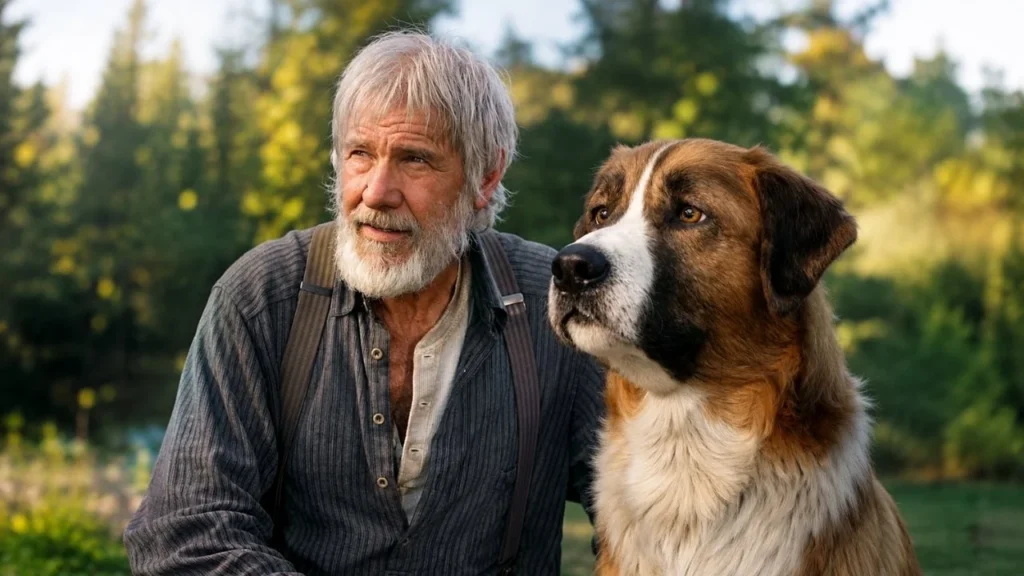
Harrison Ford brings emotional depth to the 2020 adventure film alongside the digitally created Buck
YOU NEED TO KNOW
- Harrison Ford stars as John Thornton opposite the fully CGI dog Buck
- Terry Notary performed Buck’s movements on set as animation reference
- MPC built Buck using strict real dog physiology, avoiding human like expression
- The film lost the studio an estimated 50 to 100 million dollars at release
Adventure movies built around a friendship between a person and an animal are nothing new, but The Call of the Wild from 2020 took an unusually risky approach to telling one. Rather than casting a real dog in the lead role.
The production built its central character, Buck, entirely out of computer animation, then placed him opposite Harrison Ford for nearly the entire runtime.
It was an expensive, divisive choice, and more than five years later, the decisions behind it still explain a lot about why the film split audiences the way it did.
Directed by Chris Sanders in his live action debut, the film reimagines Jack London’s 1903 novel, following Buck from a comfortable life in Santa Clara, California through his kidnapping and transport north during the Klondike Gold Rush of the 1890s.
He works his way through a sled team led by Perrault, played by Omar Sy, and Françoise, played by Cara Gee, survives the reckless mismanagement of a prospector named Hal, played by Dan Stevens, and eventually finds his way to Thornton, a grieving frontiersman played by Ford who has lost his son and retreated into isolation.
Karen Gillan, Bradley Whitford, and Colin Woodell round out a supporting cast that mostly exists to move Buck from one stage of his journey to the next.
Ford’s performance carries much of the film’s emotional weight, and doing so opposite a character that didn’t physically exist on set in its final form was no small task. He reacts to Buck with a kind of quiet warmth that makes their bond believable even in the film’s quieter stretches, sharing food by a fire or simply watching Buck explore, moments that tend to land more effectively than the film’s bigger action sequences.

The construction of Buck himself is where the film gets genuinely interesting from a filmmaking standpoint.
Terry Notary, known for his performance capture work on the recent Planet of the Apes films, physically acted out Buck’s movement and posture on set, giving animators real reference footage of weight, motion, and interaction with the environment.
Visual effects studio MPC then built the finished digital character out of that reference, working out of their Montreal studio under supervisor Erik Nash, using scans of an adopted dog to inform Buck’s physical design.
What most coverage of the film leaves out is how deliberately restrained that animation process actually was. In an interview with VFX Voice, visual effects producer Ryan Stafford described the specific rule the animation team held themselves to, that Buck could only do things a real dog could physically do, nothing more.
Stafford has since admitted that constraint may have been pushed too far in practice, since it created real friction getting a computer generated animal to consistently hit precise marks the way a trained human performer would.
It is a small production detail, but it goes a long way toward explaining the split reaction to Buck himself. Viewers who connected with the character responded to exactly that restraint, a dog that felt grounded in real animal behavior rather than exaggerated for effect.
Viewers who found him uncanny were often reacting to the same choice from the opposite direction, sensing a character that looked photorealistic but still moved with a kind of deliberate, almost performative control that a real animal wouldn’t have.
Commercially, the gamble did not pay off. The film released in February 2020, just weeks before COVID related disruptions upended the theatrical business, and it grossed roughly 111 million dollars worldwide against a production budget reported between 125 and 150 million dollars.
Multiple industry reports at the time estimated the studio lost somewhere between 50 and 100 million dollars once marketing costs were factored in, making it one of the more notable box office disappointments of that period, regardless of how the pandemic’s timing affected its run.
Even so, the film has aged into something more interesting than its opening numbers suggested. It sits in an increasingly rare category of studio filmmaking.
A big budget family adventure that isn’t built around a superhero universe or an existing franchise, using expensive visual effects in service of an old fashioned story about grief, companionship, and the pull of the wild rather than spectacle for its own sake.
Whatever side of the CGI debate a viewer lands on, the choices behind Buck’s design were far more deliberate than they might first appear, and understanding them changes how the character reads on screen.
Read More: You, Me & Tuscany Just Landed on Peacock, With a Netflix Date Already Set