Beyond the Altar: How Enola Holmes 3 Transformed the Franchise into a Political Thriller
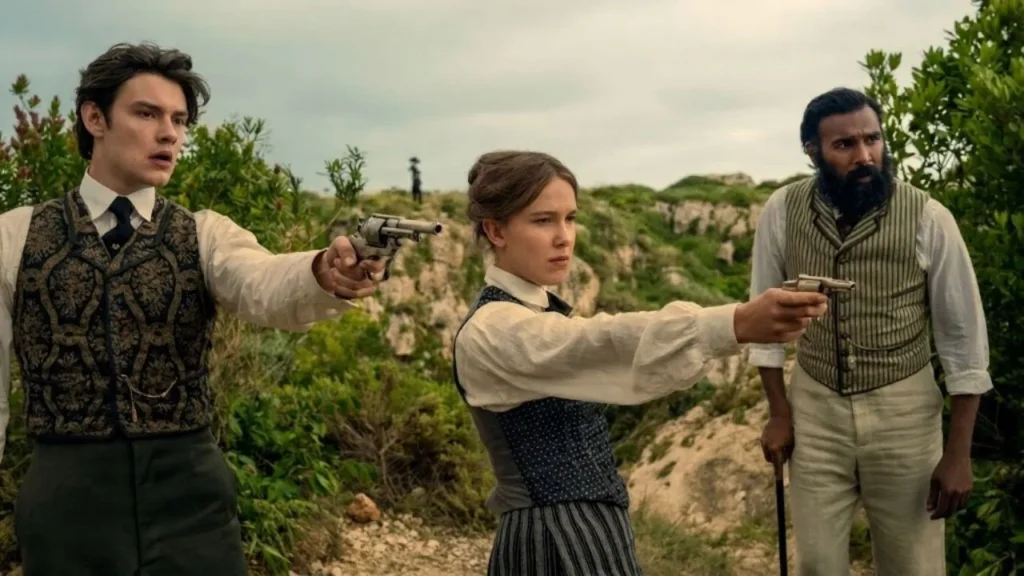
A hidden military conspiracy ties the main villain directly to the Tewkesbury family's past.
YOU NEED TO KNOW
- A familiar villain hides behind a new identity, setting the entire mystery in motion.
- A joyful celebration is interrupted by an unexpected disappearance that changes everything.
- The investigation uncovers a decades-old mystery linked to hidden treasure and wartime history.
- The finale reshapes Enola’s future with a partnership that could define the next chapter.
When a franchise establishes a reputation for lighthearted fourth-wall breaks and charming coming-of-age romance, introducing a dark military conspiracy feels like a high-stakes gamble.
Yet, when Enola Holmes 3 forces its central heroine to abandon her wedding altar to track a trail of blood across the Mediterranean, the narrative pivots from a playful teenage caper into a complex, mature political thriller.
Following its global Netflix debut, the massive wave of discussion surrounding the cinematic return of the youngest Holmes sibling has focused entirely on the intricate web of deception unraveled during the movie’s final act in Valletta, Malta.
Instead of presenting a straightforward revenge plot against the detective who put her behind bars, the narrative masterfully reveals that the high-profile disappearance of London’s greatest sleuth was never the ultimate goal.
The mastermind behind the curtain, operating under the brilliant alias of Professor Adeline Rathe, used the high-stakes abduction as a giant piece of misdirection to keep everyone looking the wrong way.
By tracing a series of encrypted breadcrumbs left behind in a ransacked hotel room including a Morse code message spelling “Khost” smeared across a mirror our young detective uncovers a massive imperial cover-up stretching all the way back to the historic Battle of Khost in Afghanistan.
The structural brilliance of this specific mystery relies on the realization that the villain was playing a grand game of reverse psychology.
Knowing Enola possessed the unique access to the Tewkesbury family history, Professor Adeline Rathe ultimately revealed as the escaped Moriarty manipulated the entire wedding setup in Malta, forcing Enola to do the heavy lifting and lead her straight to a stash of stolen Afghan gold.
By replacing cozy Victorian tropes with real-world sociopolitical commentary on imperial corruption and framed military scapegoats.
Enola Holmes 3 delivers the franchise’s most sophisticated entry yet, proving the young detective can navigate far darker, mature waters without losing her signature spark.
The antagonist deliberately manipulated the entire timeline even pulling strings behind the scenes to ensure the Tewkesbury family selected Malta for the nuptials knowing that the youngest Holmes would inevitably lead her straight to a legendary cache of hidden Afghan gold stolen by corrupt British officers decades prior.

The climax shifts from a simple rescue mission into a tense, multi-layered standoff inside a subterranean cavern, where the lines between colonial duty and outright piracy become completely blurred.
Watching these elaborate period pieces unfold reminds us of how beautifully modern cinema can balance heavy historical subtext with brilliant, show-stopping aesthetics.
Audiences love dissecting the meticulous visual choices that define these blockbusters, whether they are analyzing the underlying lore of a Enola Holmes 3 Netflix release or obsessing over a striking real-world fashion moment like the viral Millie Bobby Brown naked dress that dominated red carpet discussions earlier in the year.
The film thrives because it refuses to treat its audience like passive observers, delivering a dense, fast-paced puzzle that treats historical geopolitical tension as the ultimate weapon.
The thematic core of this finale goes far deeper than a standard villain unmasking because it deliberately flips the traditional Holmes architecture on its head.
For more than a century, Sherlock has existed as the apex predator of deductionan untouchable intellect who rescues the helpless and solves the insoluble.
By positioning him as the hostage who genuinely requires saving, the story strips away his classic armor and introduces a profound layer of human vulnerability.
Sherlock isn’t just physically trapped; he is conceptually outmaneuvered in a territory where his traditional London street networks are entirely useless, forcing him to rely completely on his younger sister’s evolution.
This rescue operation serves as the definitive turning point where the youngest Holmes sheds her status as a brilliant apprentice to stand as an absolute professional equal.
Throughout the subterranean climax, her choices are no longer driven by a desire to prove herself to her older brother, but by an independent moral compass that recognizes the broader geopolitical corruption at play.
When she successfully talks her bruised, furious brother down from executing their nemesis in that dark Maltese cavern, she isn’t just saving a life she is taking control of the family’s ethical legacy, demonstrating a psychological maturity that her brilliant brother occasionally lacks.
Meanwhile, the resolution of the stolen Afghan gold forces a massive re-evaluation of the aristocratic foundations supporting the entire narrative.
The revelation that the late Lord Tewkesbury was deeply complicit in colonial theft completely shatters his son’s idealized vision of his family heritage, driving the young lord to ensure the wealth is fully returned to its rightful home.
This radical choice to strip his own estate of its ill-begotten historical riches has ignited intense fan debate across social media, with viewers split over whether his self-destructive pursuit of justice is an inspiring act of modern morality or a naive betrayal of his political responsibilities in the House of Lords.
Rather than offering a clean, traditional resolution, the final frames purposefully complicate the victory to lay the groundwork for an entirely different class of future mysteries.
As the newly wedded couple celebrates a quiet, non-traditional cliffside ceremony conducted by Eudoria, the camera lingers significantly on the sunken wreckage of the military vessel below the waves.
This specific visual clue, heavily tied to the primary alias used by their adversary, serves as an explicit warning that the colonial conspiracy spans far wider than a single rogue mastermind.
It signals to the audience that the battle for systemic justice has only just begun, shifting the franchise from an episodic series of isolated crimes into a continuous, high-stakes war against the hidden machinery of the empire itself.
Read More: The Stream Queen: Millie Bobby Brown’s 7 Best Performances Highly Ranked In 2026 | Inside the Evolution of Enola Holmes 3: How Millie & Henry Shifted the Franchise’s Dynamic