The New Elle Woods Story Rewrites Legally Blonde.
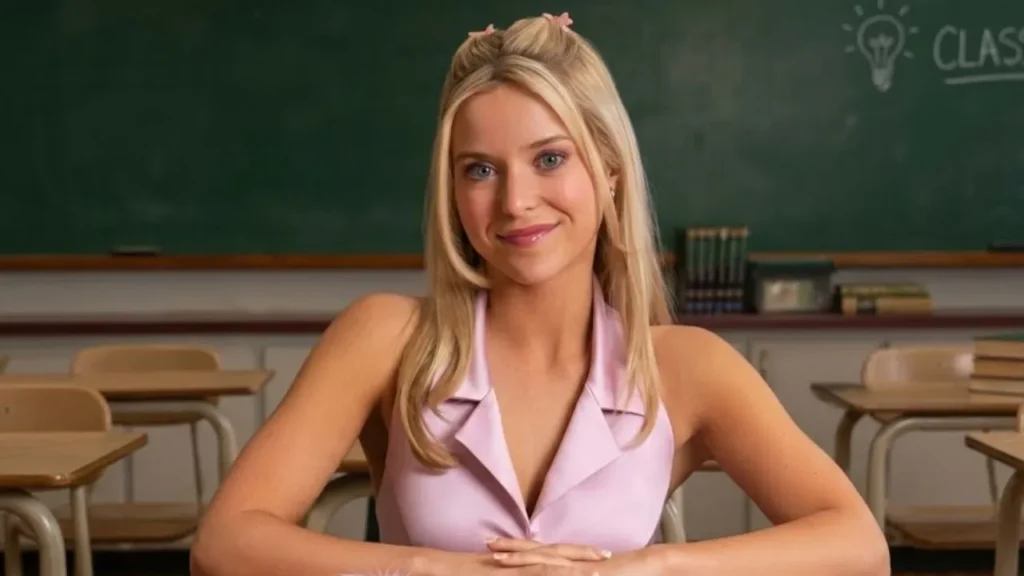
Fans notice immediate contradictions between the movie lore and the new series.
YOU NEED TO KNOW
- The prequel completely changes movie lore by moving Elle from Beverly Hills to Seattle during the height of the 1995 grunge movement after a family financial crisis.
- Fans are pointing out that if Elle already learned how to defeat bullies and cynics in high school, her character growth at Harvard in the original film is entirely redundant.
- Unlike the bright, campy comedy of the 2001 film, the series operates as a slow, sometimes dour teen drama filled with love triangles and marital strife between her parents.
- The series features one of the final on-screen performances of actor James Van Der Beek, who filmed his role as the school superintendent shortly before his passing.
For twenty-five years, pop culture enthusiasts have operated under a singular, undisputed truth regarding cinema’s favorite pink-clad icon: Elle Woods went to law school strictly because a boy named Warner Huntington III told her she wasn’t “serious” enough. It was the absolute catalyst for the entire Legally Blonde universe.
The premise of the 2001 film relied entirely on the fact that Elle was a brilliant, fashion-merchandising major who had never given a single thought to the justice system until her heart was broken.
But with the arrival of Prime Video’s new prequel series, Elle, streaming platforms have completely rewritten the rulebook on her timeline.
The eight-episode project, executive produced by Reese Witherspoon herself, takes audiences back to 1995 to explore Elle’s junior year of high school.
While the nostalgic, needle-drop-heavy soundtrack and immaculate wardrobe choices perfectly capture the era, the writing team has introduced a massive structural change that fundamentally alters the character’s motivation.
Instead of keeping Elle entirely detached from the world of advocacy until her college graduation, the prequel establishes that her moral convictions and interest in defending the innocent actually began a decade earlier.
In this updated timeline, a sixteen-year-old Elle played by breakout star Lexi Minetree is abruptly uprooted from her glamorous Beverly Hills sanctuary and dropped into the rainy, flannel-coated reality of a Seattle public high school following a financial scandal involving her father.
This fish-out-of-water scenario mirrors her eventual arrival at Harvard, but the stakes are entirely different. Rather than trying to impress a wealthy boyfriend, high school Elle finds herself entangled in a local investigation when her school principal is accused of embezzling funds.
Throughout the series, Elle uses her hyper-specific attention to detail and knowledge of social dynamics to investigate the mystery, ultimately discovering a knack for uncovering the truth.
While this makes for compelling teen television, die-hard fans have quickly noted that giving Elle a teenage background in amateur sleuthing directly clashes with the narrative of the original film.
In Legally Blonde, her sudden 179 LSAT score and spontaneous legal genius were shocking precisely because she had spent her entire life focused exclusively on the social hierarchy of Malibu.
This tension between retaining a classic story and building an engaging modern franchise is something entertainment reporters have been tracking heavily this summer.
The intense online discourse regarding these character changes shows just how protective audiences are over legacy lore, a phenomenon that isn’t unique to television reboots.
You can look at the incredible scrutiny surrounding the recent Taylor Swift wedding NDA leaks to see how quickly the public will dissect every fine detail of a narrative when public figures or beloved icons are involved.
When a story holds that much cultural real estate, any deviation from what people expect immediately becomes front-page news.
The prequel also updates her visual evolution, showcasing how her trademark look was less of a permanent birthright and more of a shield built through teenage trial and error.
Seeing a young girl navigate the rough edges of high school cliques requires a delicate balance of vulnerability and style.
This specific aesthetic intersection where high fashion meets raw, real-world drama continues to dominate the pop culture landscape.
It is the exact same energy that drove the viral internet fixation over the Kendall Jenner Australia outfit Jacob Elordi paparazzi moments, where every garment worn by a modern star is analyzed for deeper subtext.
By transforming Elle Woods from a spontaneous genius driven by heartbreak into a lifelong, natural-born defender of justice, the new series changes the very definition of her brilliance.
She is no longer a girl who accidentally stumbled into her true calling; she is a woman whose destiny was calling her long before Warner ever broke her heart.